Tag Archive | cruising the ICW

An Eagle, a Warship, and a Murder Barge

Right of way: Nautical legal principle that establishes whether or not a particular boat
has the right to ram or the duty to dodge in any given marine encounter.

“Ahoy” is the first in a series of four-letter words commonly exchanged
by skippers as their boats approach one another.
— Sailing, by H. Beard and R. McKie

“Schmidt!”
Phil Decker, S/V Catmandu

Leaving Annapolis

As we made our way out of the crowded fairway of Back Creek, Phil noticed a large bird flying solo over the harbor. “Could that be a bald eagle?” he asked.

“No, I think it’s too small,” I said. Just then, it landed on the green channel marker next to us, its large white head gleaming in the early sunshine. It perched there, looking like a sculpture – like the symbol of freedom it is, and I admitted I was wrong. “Oh, yes,” I said, “That’s an eagle.”

“A good omen,” said Phil.
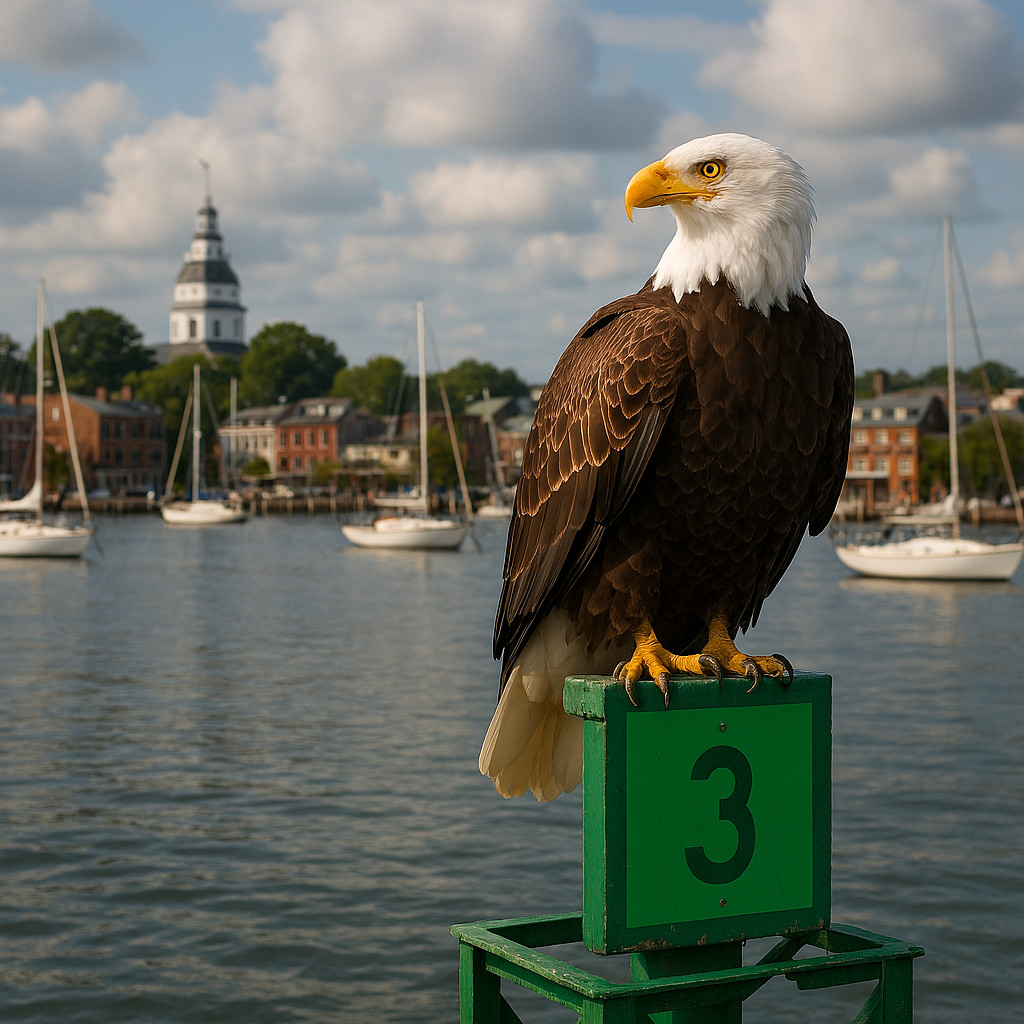
This is AI generated from my prompt: Show an eagle in Annapolis Harbor on a green channel marker. I was impressed that AI knew a green channel marker would have an odd number.

We turned into the wind and raised the mainsail. So it began, the best day of sailing either of us can remember. We were headed to warmer weather, but first, a clear cold day with perfect wind and sea conditions made us wish we could stay longer and sail around the Chesapeake. We unfurled the jib and headed southeast with a 10-knot wind from the northwest. Within ten minutes, the engine was silent and Catmandu was flying over the water, reaching speeds of 8.6 knots in favorable current. We were thrilled.
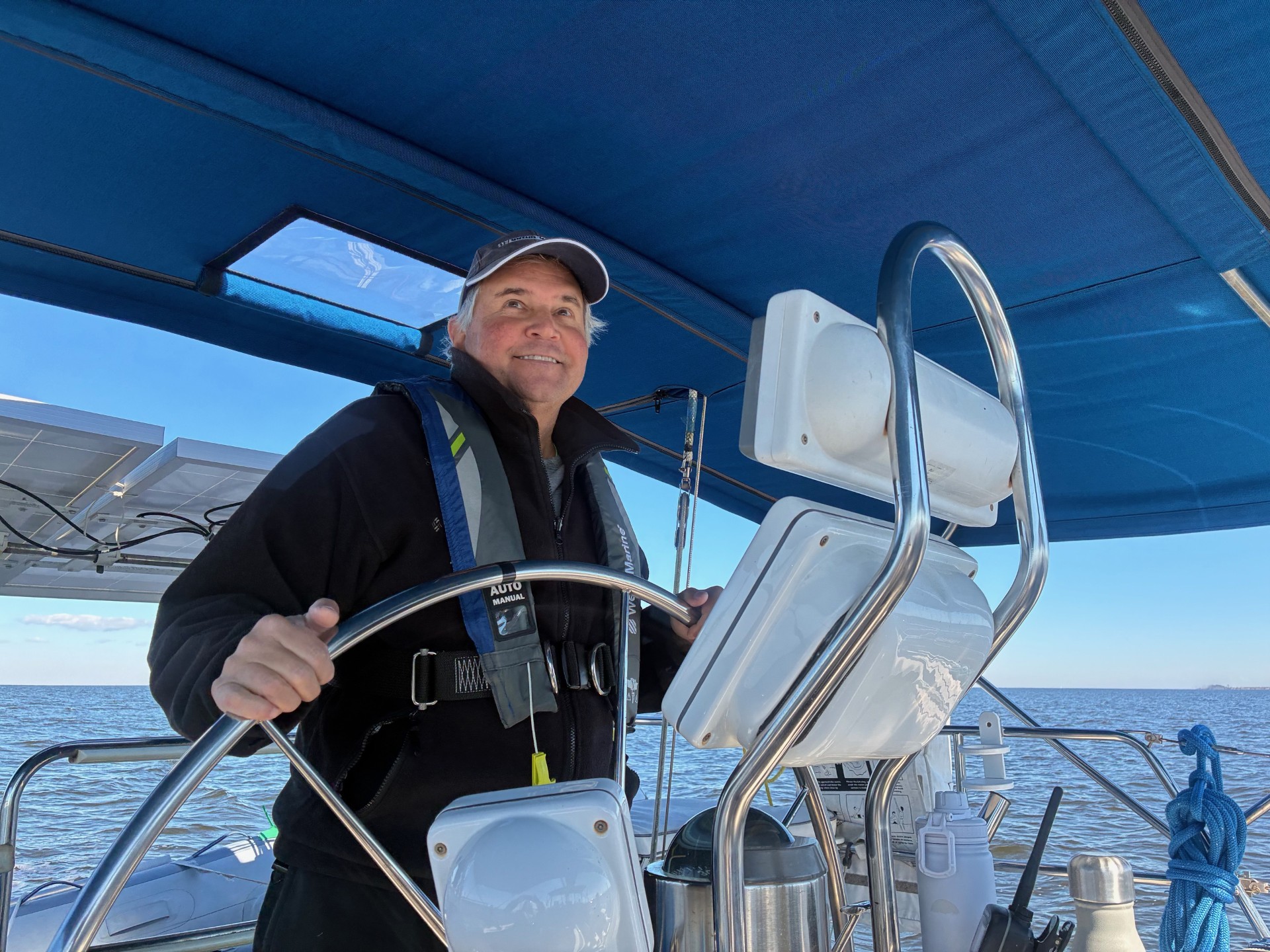
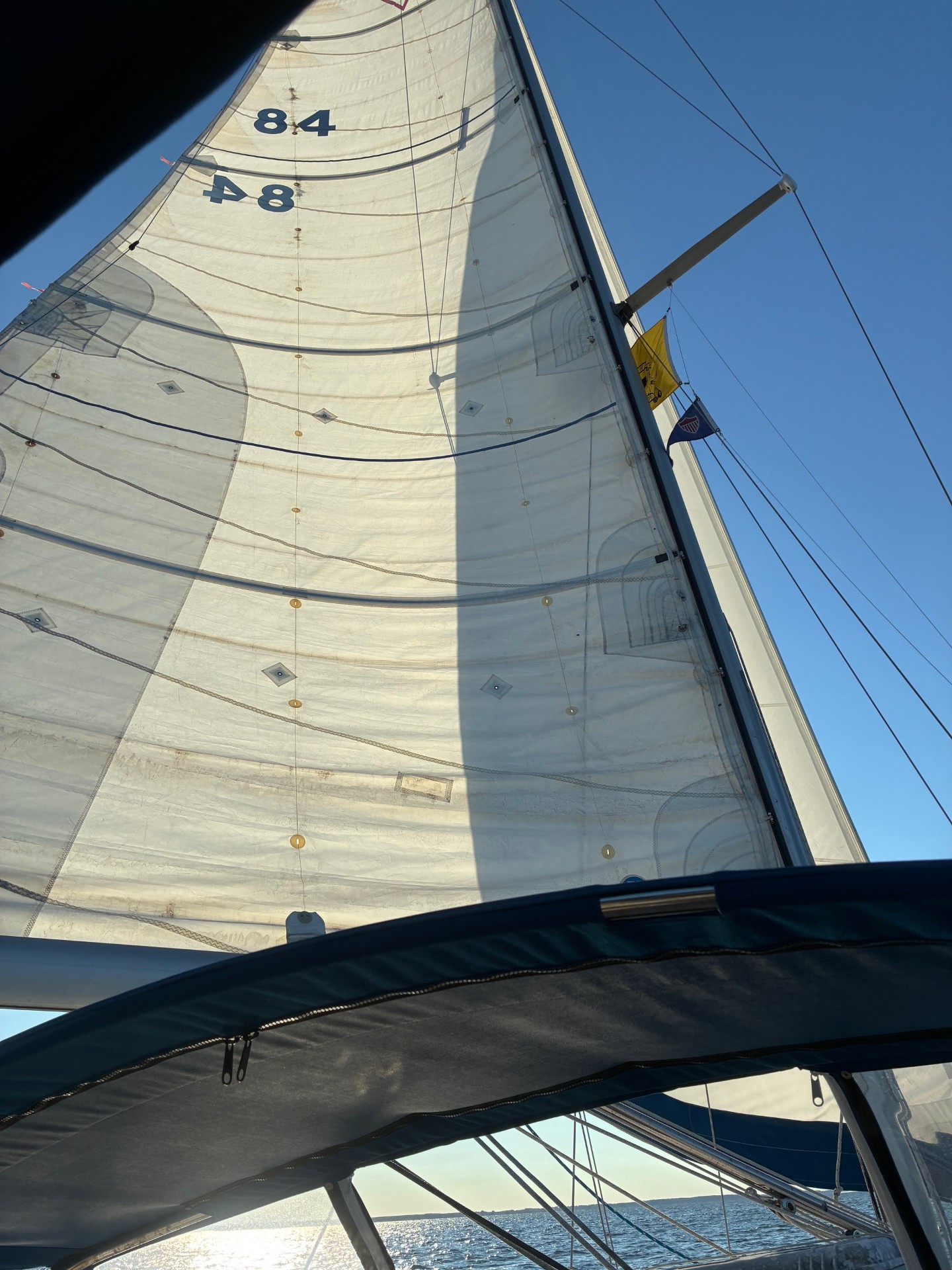
Phil, the day we left Annapolis. It was cold, but ideal for sailing southward down the Chesapeake.
Full sails, flat seas, and a clear blue sky – all the things we wish for and rarely get.

When we reached Solomon’s Island, we pulled into the mooring field and searched for our reserved mooring ball. When we found it, Phil rushed up to the bow and I steered Catmandu so Phil could reach the pennant. He got it, first try, and we were celebrating in the cockpit moments later. A blue sailboat with red canvas (S/V Red Shift) came in next and maneuvered around the other sailboats in the mooring field. A woman stood on the bow and shouted into the wind:

“So many sailboats! I have found my people!”

We laughed and waved. Phil and I have felt this way in Annapolis, in Marathon, and recently on the ICW. The Intracoastal Waterway is now crowded with sailboats heading south, politely asking each other on the VHF if it’s okay to pass. We have found our people. (Now we follow Red Shift on No Foreign Land, an app that tracks the locations and voyages of member boats, and they follow us.)

Phil was up at dawn and checked the temperature in the cabin. It was a chilly 55 degrees. We bundled up and motored out into a rolly Chesapeake, heading to Deltaville. We anticipated a 10-hour day, but with calm seas, a sail up, and a clean bottom, we arrived in 8-1/2. We had been to the Regatta Point Marina last August, and the dockmaster Don remembered us. Being plugged in to the dock meant we had heat overnight. The next morning, Don helped us out of our slip. It was a tight turn into the fairway, and we ended up with our anchor clanging into a piling behind the boat in the next slip. With me pushing against the piling, and Don’s help at the dock, Phil got the boat straightened out and we were on our way.

In mid-afternoon, just barely into the Norfolk inlet, Phil spotted a dolphin crossing in front of Catmandu. I looked up to see two more. We had not seen dolphins this far north before. As we made a right turn toward our anchorage at Fort Monroe, a majestic wooden schooner named Godspeed appeared on our starboard side. They called on VHF asking if they could cross our bow and pass port-to-port. We slowed down and let the stately sailing ship pass.
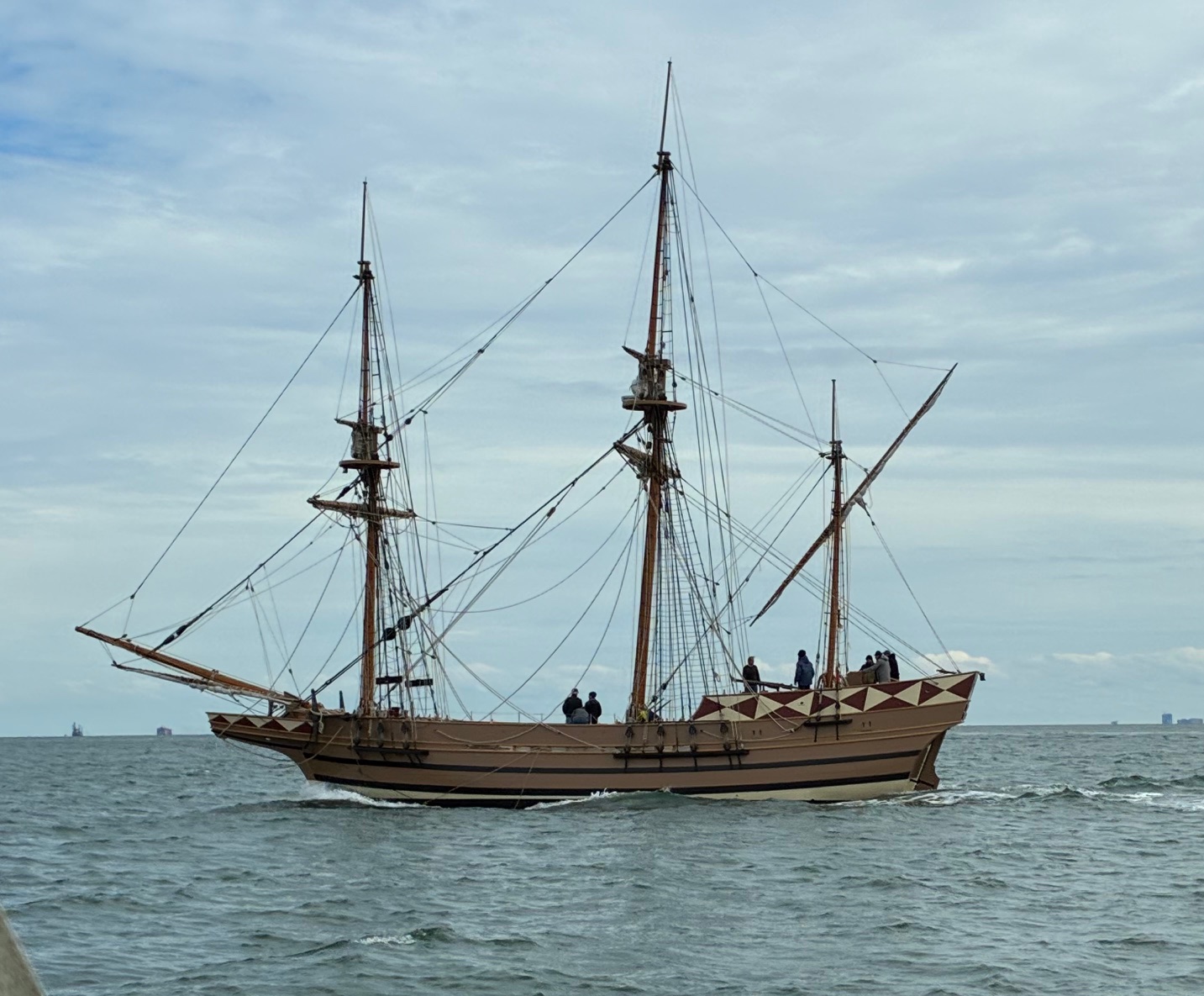
The tall ship, Godspeed, entering the Chesapeake as we exited.

Getting Through Norfolk

Catmandu spent a quiet, cold night anchored at Fort Monroe / Mill Creek (in the company of 19 other boats) and left very early to start into Norfolk Harbor. As we motored into the busy channel, a gigantic cargo ship bore down on us from the port side, and an equally enormous ship had just crossed our bow. The cargo ship gave five blasts of its horn (the “danger” signal) and just as I asked, “Was that for us?”, they radioed us by name, saying we should “stand clear.” Those ships can take up to two miles to come to a stop, and do not turn on a dime. We were only too happy to stand clear and let them pass.
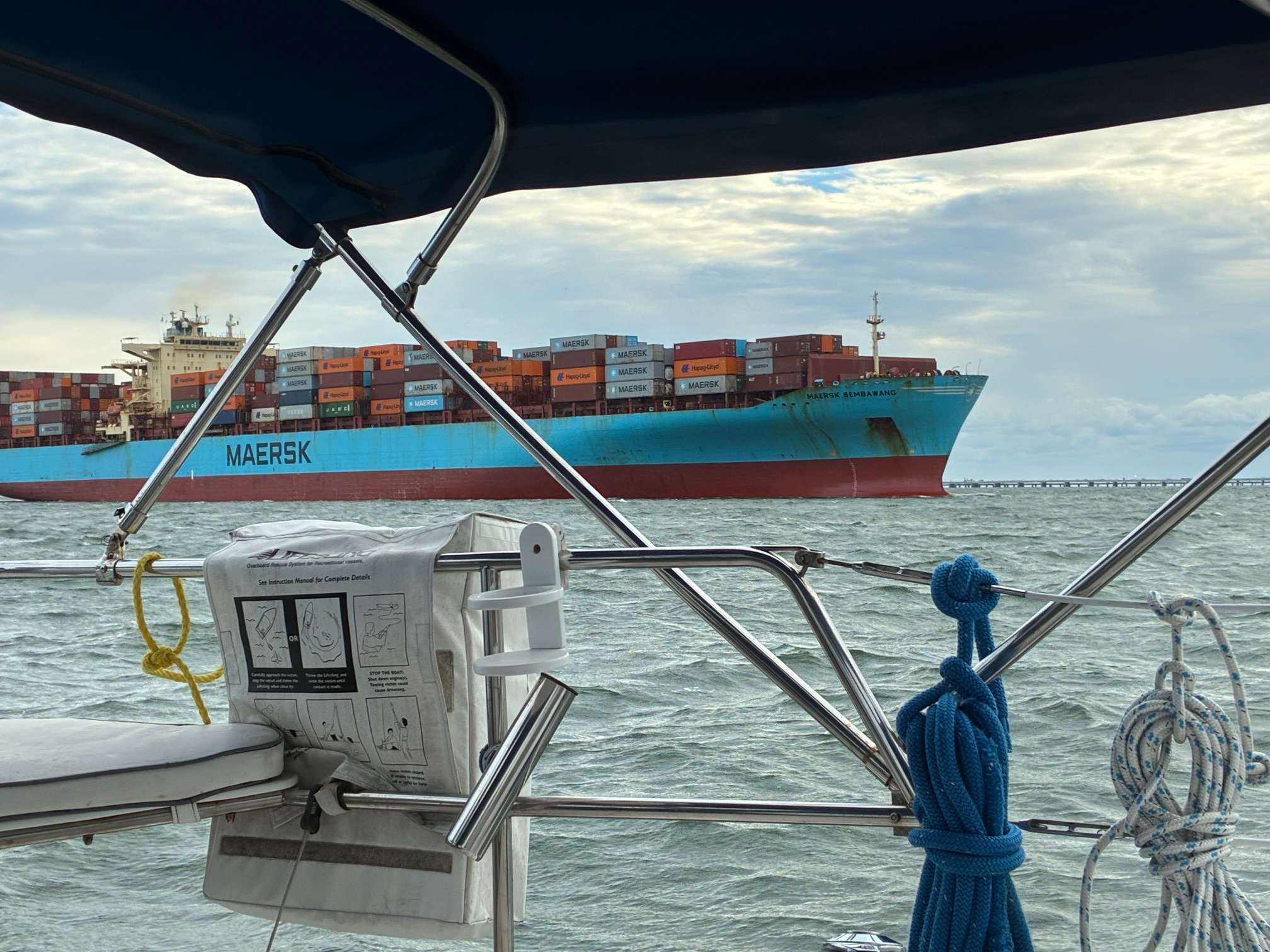
We let this mega-ship go ahead of us as we entered the channel. Anything with “Maersk” on the side is sure to be huge and barely maneuverable.

We pulled into a line of boats heading west into the port of Norfolk, hearing the constant scoldings on VHF telling captains to “Slow down! This is a no-wake zone.” Behind us, a huge Navy ship was gaining on us, forcing us to slide to the right. Phil was at the wheel, watching the port side of the channel and I was watching the encroaching Navy vessel.

“Schmidt!” Phil yelled, and suddenly our boat veered to port. I looked at Phil to see if he was okay and immediately saw the problem: a fuel barge the size of a football field was being pushed into the right side of our boat, barely 200 feet away and closing fast. The tug pushing it was not about to change course (sailboats be damned) and Phil spun Catmandu in a tight circle to the left to avoid being hit. The tugboat, the Potomac, did not call us, did not veer off, and continued as if we were not there. Only the quick action of Phil behind the wheel kept us from being pulverized.
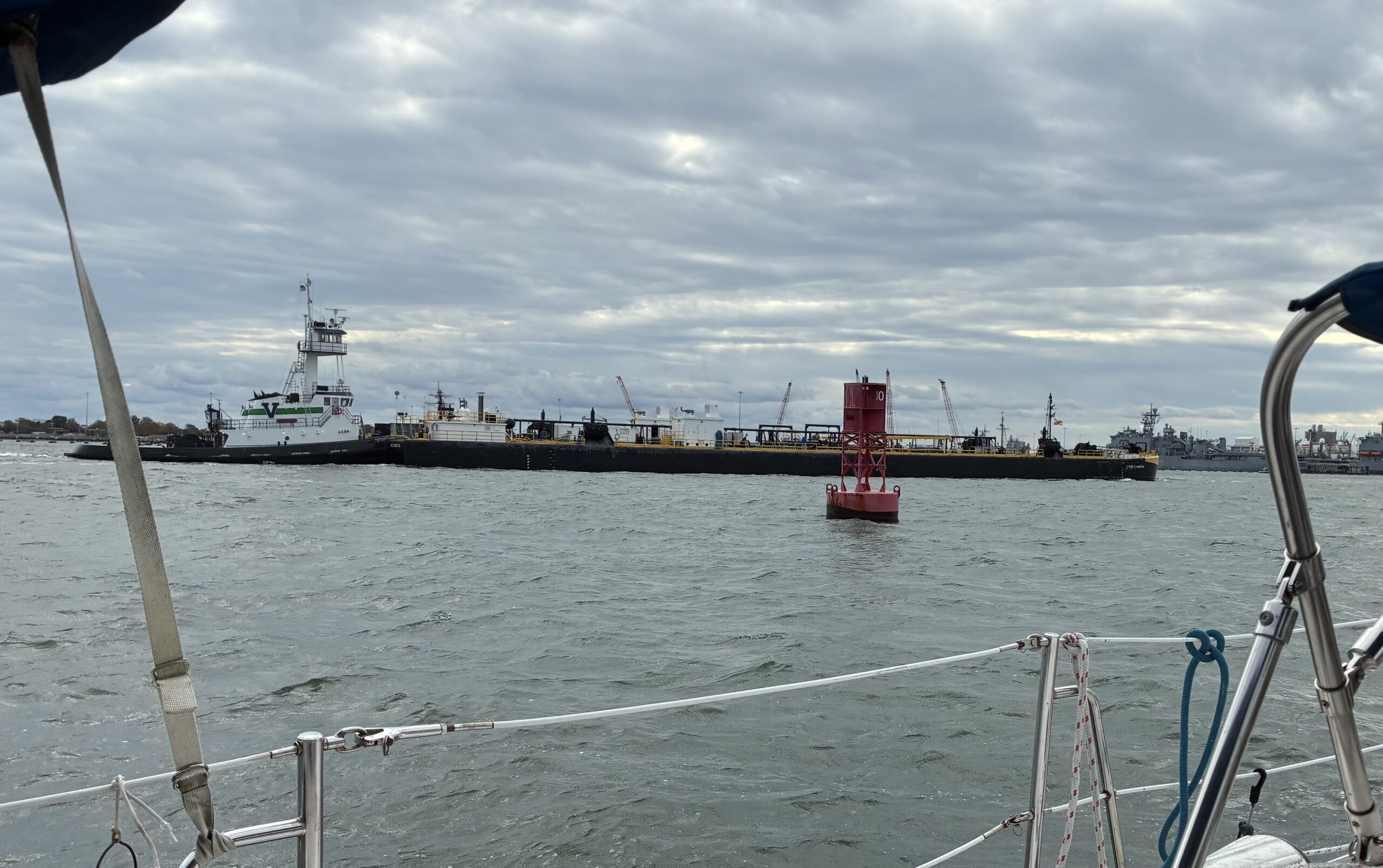
After we swerved to avoid being smashed by this fuel barge, I managed to snap this photo.

“Schmidt?” I said, after we regained our course and our composure. 

“Well, it’s not what I wanted to say,” he admitted.

“Did you get the name of the murder barge?” I asked, coining a phrase that felt appropriate.

“I got the name of the tug – Potomac,” he said. “It will go in the log.”

On to Great Bridge

At the southern end of the busy Norfolk port is a lock and bridge that lead into the ICW. The bridge has been under construction for some time, and currently opens only on the even hours between 8 a.m. and 4 p.m. The lock, a half mile away, opens in concert with the bridge. In order to make the 2 p.m. bridge, we had to be at the lock by 12:30.

Avoiding cargo ships and murder barges proved difficult but we made our way with other boats our size and soon put most of the busy Monday morning traffic behind us. Ahead of us, we saw a large Navy vessel with “29” painted on the side. There were around five tugboats hanging around and we attempted to pass the warship to the right. A sailboat in front of us slowed down and so did we. Not sure what to do, we circled behind the sailboat and waited for the tugs to do something. Several other sailboats caught up and we paraded in a circle, looking like a slow regatta. Soon no one could fit through the channel.
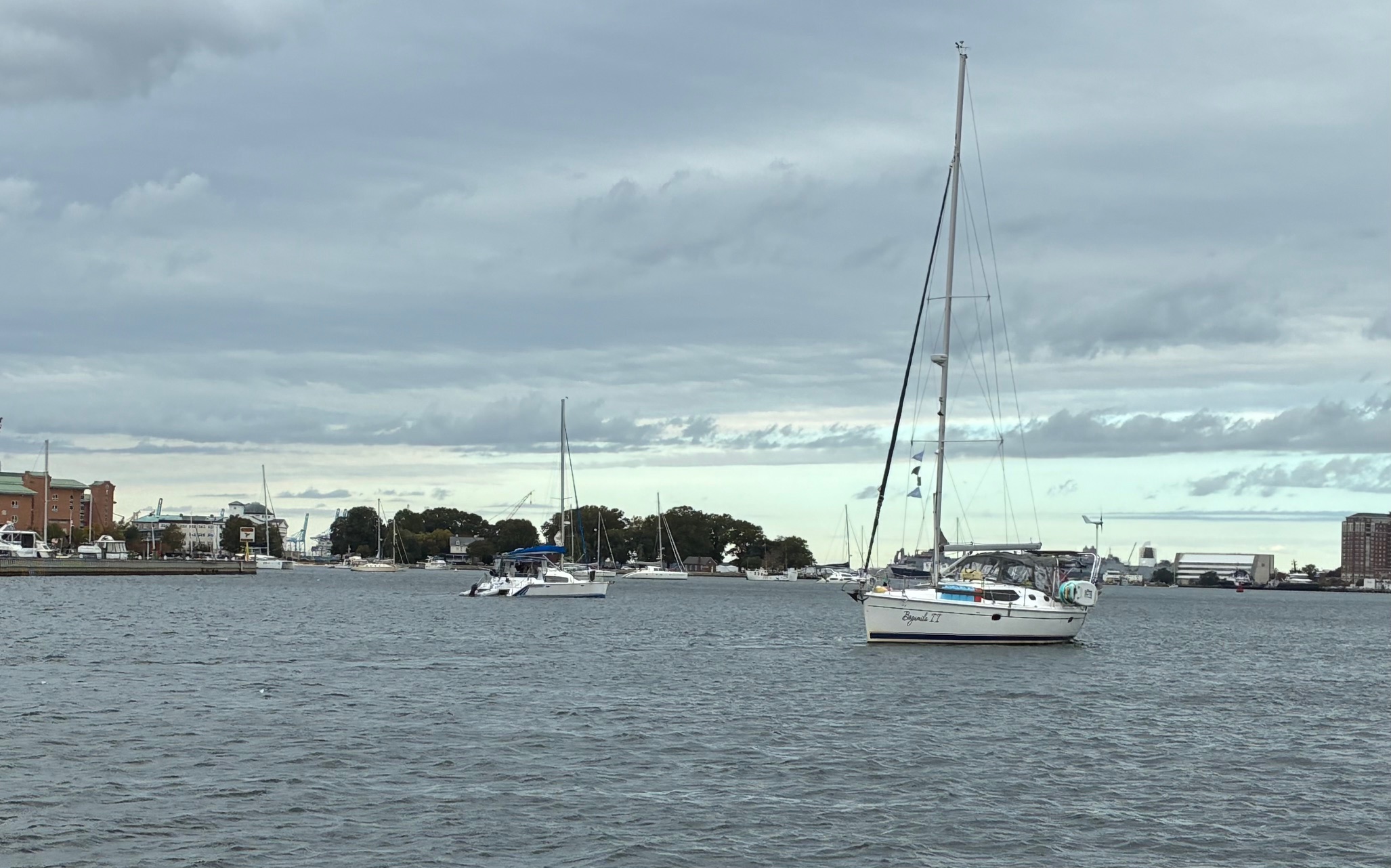
There were five or six sailboats in the boat parade, all circling while the Navy warship backed into the turning basin.

Finally, the radio squawked. “All vessels, all vessels, Warship 29!”

Warship 29 is the USS Beloit, a littoral combat ship. “We will be exiting the slip and occupying the entire turning basin. All vessels are advised to stand clear.” Since we were circling in what appeared to be the turning basin, we wondered where we were supposed to go. Soon it was made clear that we were expected to backtrack and tuck out of the way while the behemoth backed slowly into the channel, aided by tugs, and turn completely around. The sailboat parade headed back where they had come from and waited.
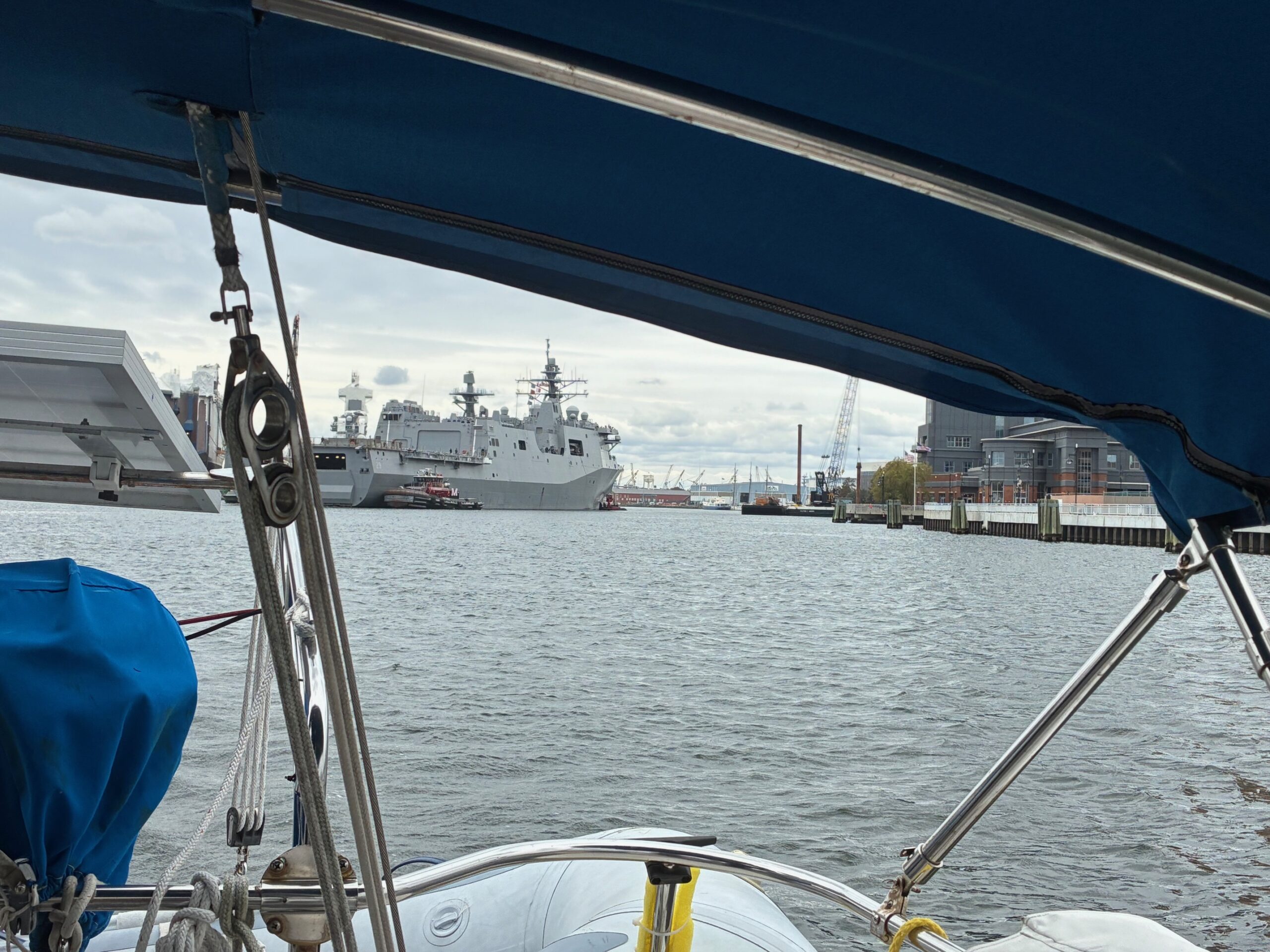
USS Beloit, blocking our way in the Elizabeth River, causing five sailboats to circle for 30 minutes while tugs pushed it into our path.

A full thirty minutes later, we were still waiting for the “all clear” when the boat in front proceeded to enter the basin again. We followed, afraid the long delay would make us miss the lock and bridge. The Navy ship was nearly turned around when we slipped past it and headed for the Gilmerton Bridge, along with our sailboat parade. After the bridge, most of the other boats stayed to the right to enter the Dismal Swamp. Our draft, at five and a half feet, is too deep for that route. Besides, who wants to enter the “Dismal Swamp”? The name alone steers us elsewhere.

We kept going and entered the Great Bridge lock on schedule at 12:30 p.m. We were the third boat to pull in, but we waited over an hour for five more boats to enter. As we waited, a graceful little baby deer ran through the lawn next to the lock and bounded into the forest beyond. It was too quick for a picture. It was adorable.
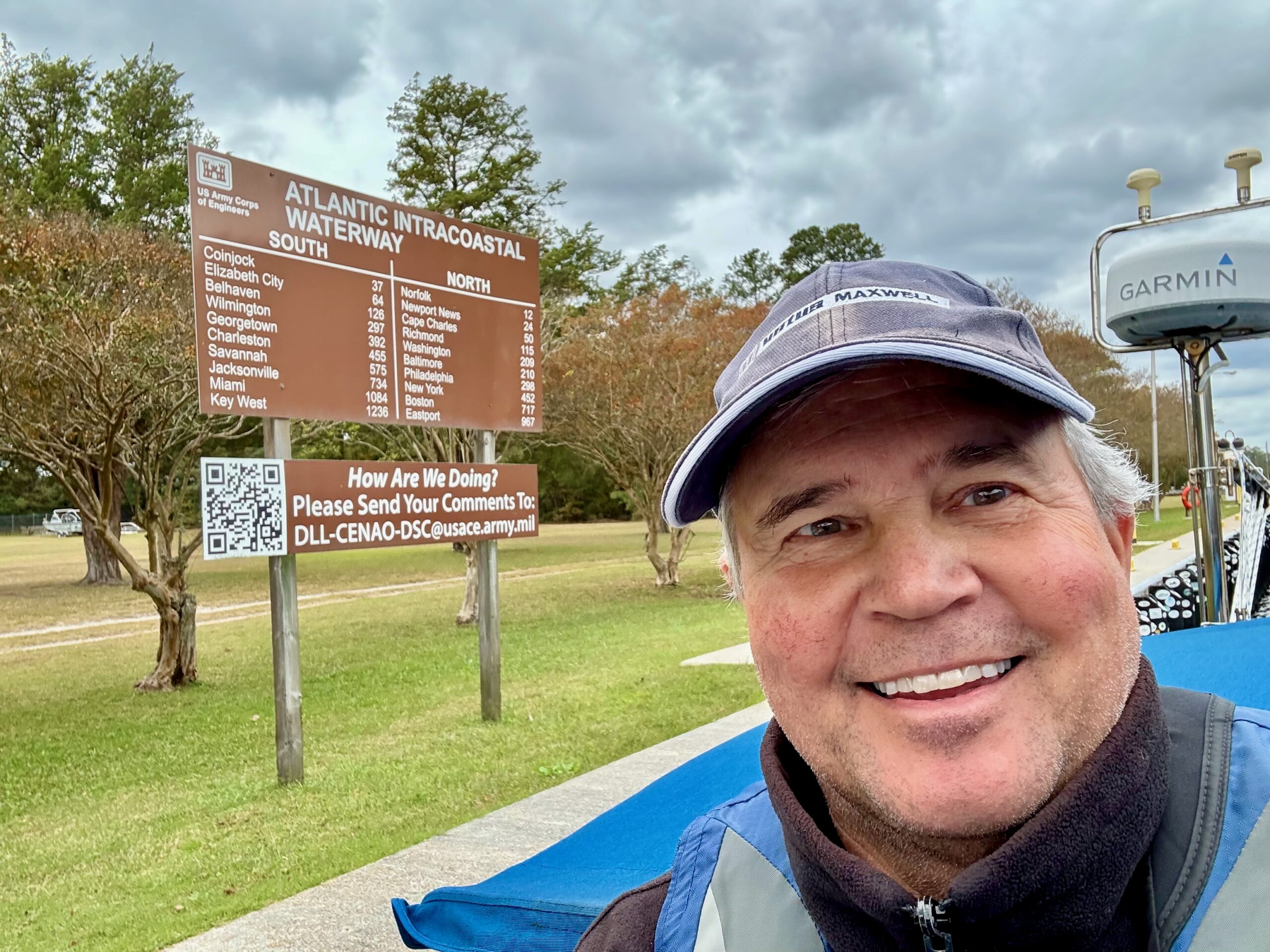
Phil at Great Bridge Lock

Gales were predicted for the next few nights, and we had no desire to anchor out or cross Albemarle Sound in that kind of wind. A gale is defined as sustained winds between 34 and 47 knots. We docked easily at Atlantic Yacht Basin and spent three rainy days and nights in our cozy boat, tied securely to the sturdy dock, far removed from megaships, murder barges and the U.S. Navy.

Going Home, Again

“Let your home be your mast and not your anchor.”
— Khalil Gibran
“‘Home’ is any four walls that enclose the right person.”
— Helen Rowland
“You Can’t Go Home Again”
— 1940 novel by Thomas Wolfe

Fleeing Summer Up the ICW

We left Hollywood Florida in mid-June when temperatures and humidity make outside living unbearable. Phil and I wanted a more temperate summer, where air temperatures drop at night and we could enjoy cocktails in the cockpit without roasting. Many “snowbirds” travel between homes in New England and Florida, but few take their homes with them.

It was late in the season to start up the ICW, and we knew it would be hot well into North Carolina. Our boat has air conditioning, but only if we are plugged in to a dock. We can also run A/C on the generator when we’re at anchor, but that can be annoying to others in the anchorage and makes it hard to sleep.

I took a week off to visit my sons and grandson in New Hampshire, leaving Phil at Titusville Marina where he could monitor rocket launches from the boat. So, we didn’t really get started until mid-July. We spent time with close friends in Melbourne, and four days in St. Augustine – one of our favorite ports – as I waited for shipment of a cancer drug I needed. Our amazing and generous friends there loaned us a car so we could pick up the package at St. Brendan’s Isle, an address cruisers know well.

Our mailing service, St. Brendan’s Isle. This is our address, but not where we live.

The slow passage through “the ditch,” as the ICW is called, took weeks. It was hot, but the waterway winding through the wilderness in Georgia and the Carolinas is stunning, revealing a landscape so remote our own anchor light was the only light we saw after darkness fell. Stars blazed overhead at night, the bright Milky Way a smear of starlight across the dark canopy.

Sunrise from our anchorage on the Santee River in South Carolina.

We were greeted by dolphins in anchorages so far from the ocean we wondered how in the world they got there. We saw egrets, ospreys and roseate spoonbills along the way, and noisy flocks of Canada geese. The spoonbills are lovely, pale pink and white like flowers. They do a strange dance when feeding, swaying their heads back and forth in the shallow water.

There were tall white shorebirds that could be Great Egrets or Great Blue Herons in white phase. (You have to see their leg color to tell the difference.) Dolphins seemed to swim with us unseen, just popping above the surface to delight us now and then at sunrise or just as we were dropping the anchor. Sometimes they had little ones with them, just two or three feet long.

In Hilton Head, they warned us about alligators. In North Carolina, we saw one in the Pungo River.

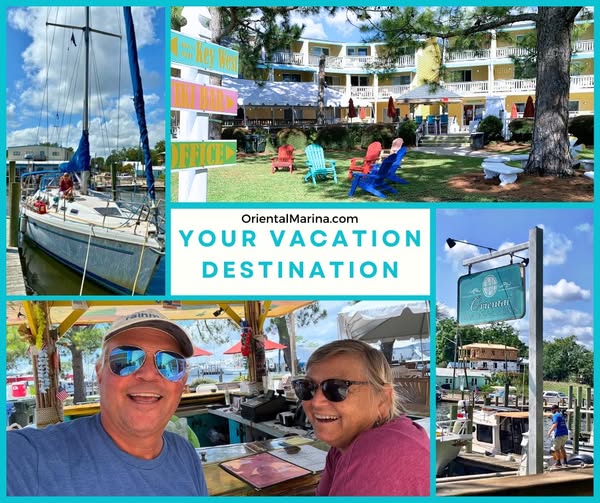
Catmandu cruised through the quiet and lovely Waccamaw River, reminding me of Kipling’s “great gray-green greasy Limpopo River, all set about with fever trees.1” We didn’t love Morehead City Yacht Basin, but it was quiet compared to Mile Hammock anchorage, where giant military Osprey helicopters took off and landed in a deafening roar every ten minutes until midnight, looking like giant angry grasshoppers. The next day the calm of Adams Creek made up for it. We stopped at Oriental Inn and Marina, and made an appearance on their Facebook page.

We showed up in a Facebook post for the Oriental Inn and Marina.

Going north through the lock at Great Bridge, we were one of only three boats and planted a Catmandu sticker on the bumper piling. With ICW Mile 0 behind us, we headed through Norfolk listening to one very loud man on the radio yelling at boaters to slow down in the no wake zone. Weather turned windy and rainy at the mouth of the Chesapeake, pinning us in Deltaville for three days. 

I have to admit, we were a little cold approaching the Chesapeake.

At Home in Annapolis

We arrived in Annapolis near the end of August. It was unusually cool. We had been wearing our sweatshirts since North Carolina and loved the fall in the air. Good friends from Fort Lauderdale took us to the airport the next day so we could fly down to retrieve our car and return with it on the Autotrain, an experience that deserves its own blog. Then, a week later, we were flying to Greece for a Catamaran sailing adventure with many friends, another blog. We didn’t have a chance to miss home; we were moving too fast for that.

Living in our boat on the hard was like living in a treehouse.

The boat work didn’t start when it should have, and Catmandu (our real home) was still up on stands when we arrived back at the Port Annapolis boatyard. We stayed in a hotel for a week, then moved aboard, entering and exiting via a stepladder to the cockpit.

“It’s like living in a treehouse,” Phil observed. A week later, the boat work was done (the credit cards were severely abused), and we were finally back at home, in the water, ready to enjoy Annapolis. Our old friends gathered on our boat for docktails; we attended the Seven Seas Cruising Association (SSCA) gam2; worked in the SSCA booth at the Annapolis Boat Show; and made new friends. It was almost too “social” for me, but we felt a sense of belonging. It would be hard to leave.

Going Home to NH

New Hampshire is where I’ve spent the most time in my adult life, and where my older son lives with his wife and my grandchild, Lucas. We headed north for a long weekend visit on the occasion of Lucas’s first birthday. How could I resist?

I couldn’t stand to miss my grandson’s first birthday. Here’s Lucas with mom, Maeghan and my son, Anthony.

After a brief visit with my sister Janet in Connecticut, we drove through Vermont in mid-October, with the orange, yellow and red leaves of autumn on full display through the Green and White Mountains. I will never tire of this; fall in New England smells like hot apple cider and wood fireplaces. Leaves crunched underfoot as we walked through the orange woods to a clear, cold lake on a sunny Saturday morning.

“I hate to say it,” I said to Phil as we were heading south again, “But this feels like home to me.”

A visit to see family in NH made me realize how much I missed the ideal October.

I cried silently the morning we left, hoping Phil didn’t notice as he drove down I-93 back to Maryland. We both knew winter would come eventually and neither one of us wanted to shovel snow or drive in it – or endure the freezing cold. Still, the sadness of leaving stayed with me for miles.

Going Home, Again

We spent just over 60 days at Port Annapolis Marina, enough to realize it was a place that welcomed boaters, specifically sailors, and a place where we could easily be at home. We have friends there and it is just a day’s drive from family. Plus, it has everything a live-aboard cruiser could want: peaceful rivers and coves to explore, a community of like-minded people, and a whole world of boat repair specialists. Perfect! Except, it also has Winter.

It was 7:20 on a chilly October morning in Annapolis when our beloved friends Dan and Jaye helped us cast off our lines. They took pictures as we left the dock and wished us well on our voyage home — that word again.

Catmandu, leaving Annapolis.

We were back on Catmandu, with its new coat of bottom paint and freshly repaired rudder and cutless bearing. We flew away from Annapolis with full sails out, speeding down the Chesapeake on a perfect day of sailing – wind on the beam, sunny skies, no engine on. It was, as Phil pointed out, the best and longest day of pure sailing we’ve ever had on our boat. We made it all the way to Solomon’s Island and burned maybe a tablespoon of diesel.

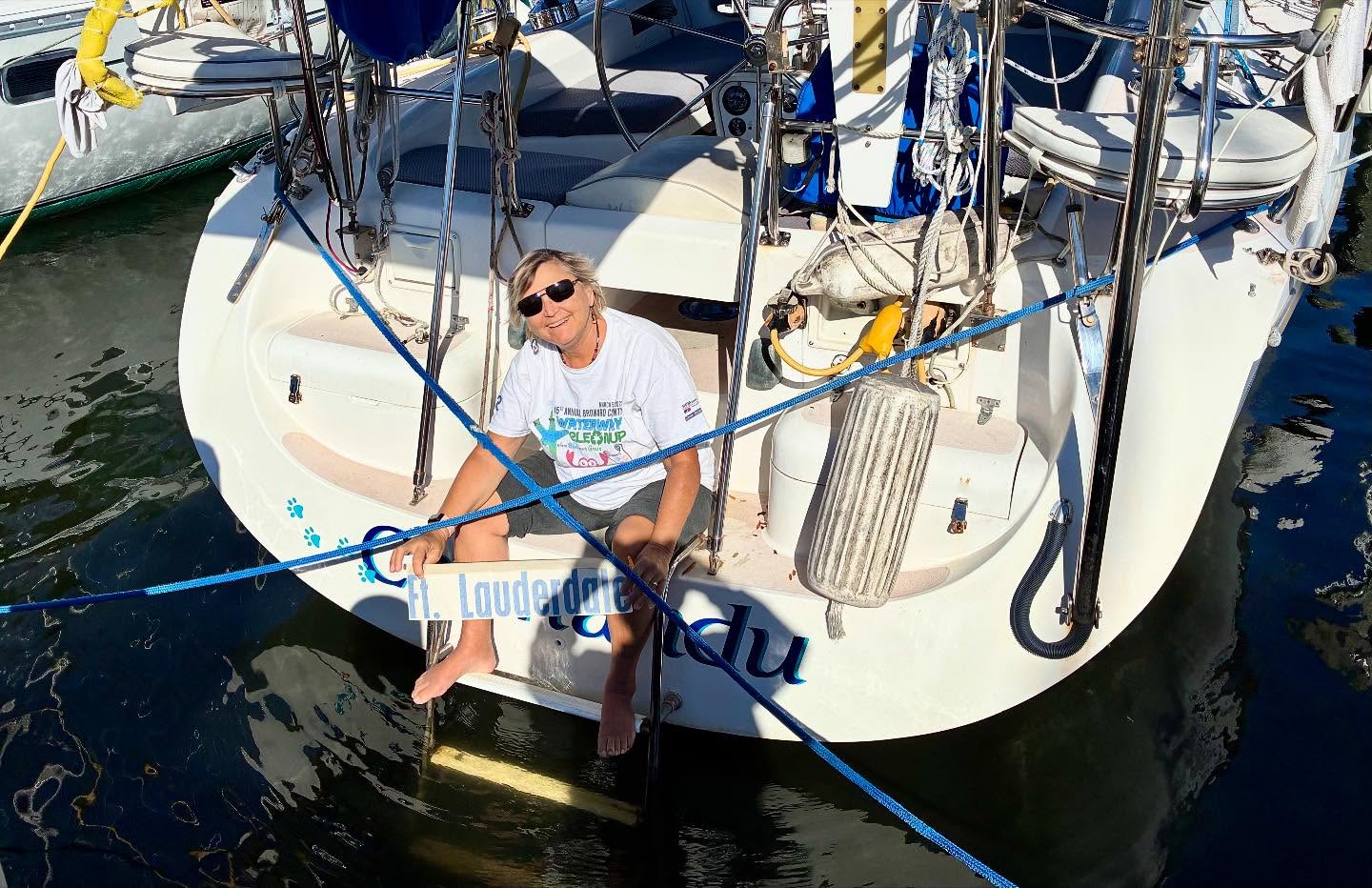
Now, we are heading south and fleeing winter. Our destination, Fort Lauderdale, may or may not be home, but it is a place where we settled years ago, had jobs, joined a sailing club, and still have many friends. It’s the location named on the transom of the boat, our hailing port.

“So, where’s home?” people ask us when we meet at a marina or an anchorage. We usually look at each other because we don’t know the answer. Phil grew up in Minnesota; his family is there. I grew up all over the country; my family is scattered. Instead of explaining our complicated concepts of home, we blurt out whatever we are feeling at the time: Minneapolis, New Hampshire, Fort Lauderdale. Or, the best explanation:

“We live on our boat.”

Home is not always where the anchor drops. Home is where people who love you are sorry when you leave and delighted when you return. By that definition, we are blessed to have many homes: some we visit briefly and return to often, and some we visit rarely and treasure with our whole hearts. For me, home is where Phil is, on Catmandu, the home we bring with us.

Phil, at home on Catmandu.

Notes

  1. From Rudyard Kipling’s Just So Stories, “The Elephant’s Child,” a favorite bedtime story
    my father read to my sisters and me. ↩︎
  2. Gam: A gathering of sailors to exchange news, information, and experiences. It’s three days of seminars, social events, and sharing. ↩︎